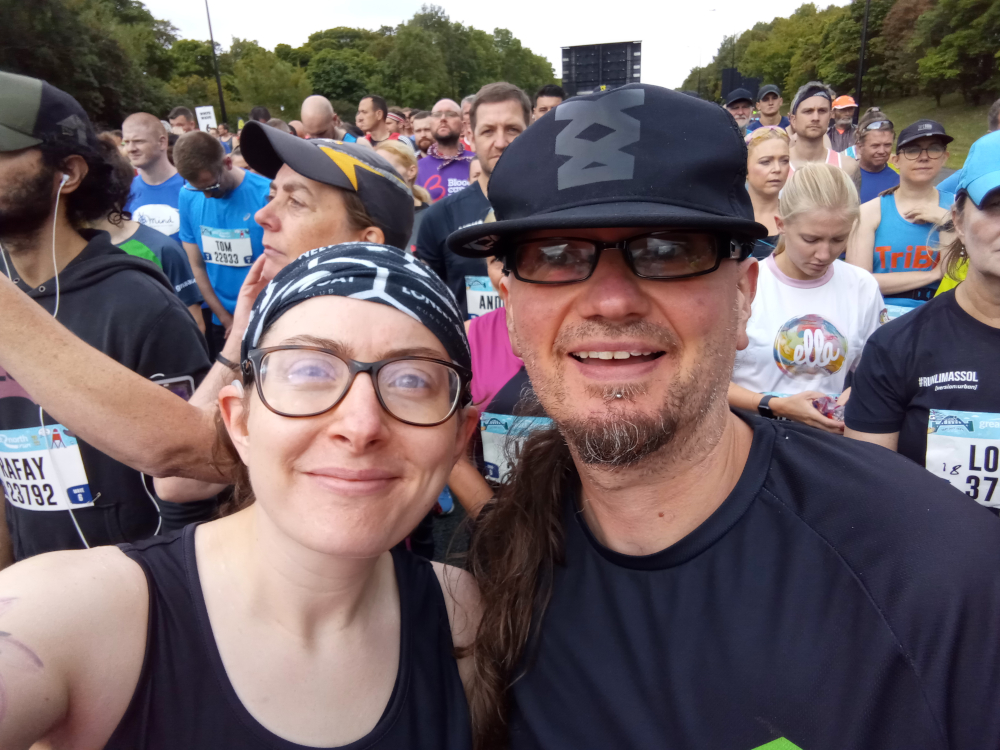
I’ve been a bit too busy recently to blog about things beyond my weekly phone boxes, largely because the first quarter of the year has been taken up with game-making. There has also been a lot of health and fitness stuff going on behind the scenes, though, and I’m in a very different place to where I was after the Winter Warmer half in early February.
Spondylitis-wise: the flare-up lasted about another five or six weeks after the half and only really subsided in mid-March. This meant that I couldn’t really follow the 10k training plan I’d hoped to do after deferring Manchester Marathon and giving up on my marathon training plan. During that time I just muddled through, did what I could do and didn’t push through the pain. Over the last two or three weeks, though, I’ve been able to run completely without pain and to keep up with others (just about!) when I go to the TMBR social runs. Running is feeling really enjoyable again and I hope that continues.
Part of the reason the condition has largely retreated for now, I think, is because I’ve been absolutely religious about doing all the strength and conditioning recommended by my physio. I have a set of exercises I do before every run, a set of exercises I do after, and a rehab-focused set that I do every evening. I’ve made it a real priority and it is working, so I need to make sure these habits don’t slip away again.
In terms of medical treatment, I’ve been to see the hospital consultants and have agreed to start biological therapy. This is a bit of a lifestyle change as it means I’ll have to start being much more careful about my immune system, watching out for infections, protecting my skin etc. I am nervous about it. But if it can help with the spondylitis to the extent that I’m not stiffening up painfully during long runs anymore, it’ll be worth it. There’s also a likelihood that it could help control my chronic uveitis, which would be a real bonus.
I have a race tomorrow – the North Tyneside 10k. The last time I ran it, in October 2021, my then-undiagnosed spondylitis kicked in about two miles after the start and I was dragging a dead leg by the end. The pattern of my current running, with everything I’ve described above, suggests that this should not happen again – but I’m still really anxious that it will. I haven’t run a spondylitis-unaffected race since London Marathon 2021 (with the possible exception of the Blaydon Race last year, but I had a ton of other issues going on in that one!). It always shows up at the worst possible time – even if I’ve been pain-free for weeks leading up to the race. I am scared. We’ll have to see.
Putting the spondylitis aside (because, as ever, it’s out of my control), I shall set some goals:
Goal A: 59:59 (this is completely pie in the sky. I’ve wanted a sub-hour 10k since I started running eight years ago. I’d love to get it this season and will be entering every 10k I can… but I know I won’t get it tomorrow. I’m not there yet)
Goal B: 1:03:29 (this would beat my fastest 10k split ever – again, this is perhaps a bit ambitious at the moment)
Goal C: 1:04:40 (this would beat my fastest 10k race result ever – again, not hopeful)
Goal D: 1:09:09 (I’d be happy with sub-1:10 tomorrow)
Goal E: 1:20:17 (this would be a course PB due to the disaster in 2021. I should be well within this unless I have another disaster)
Goal F: finish (I really hope things do not come down to this)
Despite my nerves about this race, I am generally in a happy running place at the moment. In general I feel hopeful for the first time in ages. I hope tomorrow doesn’t do anything to spoil that.
Geth’s injury saga has rumbled on for a few weeks now but we’re hoping he’s at a turnaround point. We don’t know 100% what the injury actually is (different professionals are of different opinions), but it’s a metatarsal problem, possibly a fracture. The instigating factor was a bad fall when he was still marathon training (he gave up on the marathon plan once the issue became apparent). The pain got a lot worse this last Tuesday – to me it’s clear that this was because he’d spent a week on his feet walking back and forth to work. The GP had told him not to run for 4-6 weeks but he felt he could still walk! He’s now on enforced total rest and it is working. The question is how we get him back on his feet without it flaring up again, and also how he’s going to keep his fitness up in the interim.
I’ll try and get the race review blog up in the next few days. I’ll also try and keep up with posting life updates a bit more frequently!
Not the best title. The ‘This Girl Can’ event isn’t a race, not being timed or having winners or anything. Also, it took place nearly a month ago now, on International Women’s Day on 9th March. I am really behind with my blogging (watch out for two years’ worth of gig reviews coming soon…ish…possibly). Nevertheless, I wanted to get this ‘race’ review out now, before my next race this coming Sunday. Hopefully I’ll be quicker to blog about that one!
I had heard about the annual IWD ‘This Girl Can’ 5k on the Town Moor years ago, but had never run it before. I don’t tend to do fun runs or non-timed events because I’ve traditionally been quite result-focused (I may be a slow runner but I do care about these things 🙂 ). However, a few people in my running group were doing it this year, and it seemed like a nice thing to do with friends, and it was a free event, so I decided to sign up and give it a go.
With the rest of the TMBR girls who were doing the run. Photo from Chelsea at TMBR.
The half marathon I’d done at the beginning of February had been a real knock both mentally and physically, and in early March I was still struggling with the same spondylitis flare-up. I’d only been running short distances in the intervening time, and I knew it would just be a jog round on this occasion (I was quite pleased with 34:08 in the circumstances, even if the course was a bit short!). Still, it was lovely to be running in an event again and to feel part of something.
They were giving out a choice of either a cotton t-shirt or a tote bag at the start, which was nice for a free event! Our group managed to snag the last few t-shirts, and then at the end they were trying to get rid of the tote bags as they had some left over so I ended up coming away with both – win.
It was a lovely atmosphere and I would absolutely run the event again. I’ll probably be back next year.
I’ve been having a lot of ankylosing spondylitis flare-ups recently, and they’ve been really scuppering my long runs (and sometimes my shorter runs). It’s not just the pain; it’s also the seized-up stiffness that means my legs won’t move properly and running becomes impossible – or at least not possible without the kind of limp and imbalance that will cause inevitable further damage in the long term.
I’ve been managing this for the last few weeks by taking a lot of extended walk breaks on my long runs (e.g. run a mile, walk a mile – or do this for alternating half miles). I’ve been able to maintain a steady speed doing this and I’ve felt quite good, so even though I was a bit nervous about the distance, I didn’t have any doubts about starting the Winter Warmer half this last Saturday.
The half distance for this race is four and a bit laps of the Town Moor, rather like when I did the Town Moor half in 2018, although the lap route is different. The half starts an hour before the 5k and 10k, and it was a fairly small field, the rest of whom hared off at what looked like eight or nine minute miles in the first hundred yards! As such, it wasn’t long before I couldn’t see anyone else.
I let this get into my head a bit during the first lap. I’d planned to take the usual walk breaks but I was nervous about getting further behind. I ran the whole of the first lap, but by the end of it, I was limping really badly due to my stiff, painful hip. At that point I felt like I wouldn’t be able to finish the whole distance, but I decided to powerwalk the second lap and see if I could ease things up a bit.
I felt a lot better on the second lap – I was able to keep a good brisk pace up and there were a lot more people out on the course once the 5k and 10k races got underway, so there were lots of lovely supportive comments. By the halfway point I was in a really good mood, but I still felt stiff so lap three needed to be a powerwalk lap too.
Unfortunately everyone had disappeared from the course on the third lap, so it was a bit lonely again! I wasn’t sure if they would let me go out for a fourth, but Geth appeared at the end of the lap, having long finished (along with everyone else) and also having confirmed with the race director that they would wait for me. I was determined to get the distance done by that point, so with Geth accompanying me for support, I headed out again for the final lap, vowing that I would actually run bits of this one (as apart from anything else, I was feeling really bad about keeping the race volunteers out for so long).
I took up a strategy of running to one marshal point, then walking to the next, then running to the next, etc. I got about two-thirds of the way through the lap before it became too painful to run, and I had to walk the rest of the way before limping over the finish line at a slow jog. All the volunteers were there to cheer me in, along with the Benchies in attendance that day who had all waited for me, and I got fairly emotional. My time was 3:27:51, which was the second half in a row (after last year’s disastrous GNR) where I’d ended up over an hour slower than my PB. I am hugely grateful to the race organisers and everyone who waited, but I do not want to be in this situation again.
Some decisions made since the race and some general feelings:
Geth and I have deferred our places for the Manchester Marathon to 2024. I am absolutely gutted about this, but I simply cannot guarantee that this series of spondylitis flare-ups will go away in the next couple of months. I’m really grateful that Geth offered to defer as well, as I would have found it incredibly hard if he’d done the race without me.
We will still go to Manchester that weekend. Our hotel is booked and it will be nice to take in the atmosphere, do some reconnaissance for when we run the race next year, and finally get my sub-40 at South Manchester parkrun (six years after I last ran it!).
Our replacement race for Manchester this spring will either be The Nearly But Not Quite London Marathon (Team North edition) or the Gateshead Half Marathon and 10k. The choice will depend on Geth’s soon-to-be-decided work schedule. If we do the former, Geth will go for the full marathon distance and I will do as many laps as I feel I can; if we do the latter, Geth will try for a speedy half and I will do the 10k.
The above replacement race will be Geth’s spring goal race, but not mine. My plan is to train properly for the 10k distance and try and get a PB this spring/summer. As such, I’ll be running several 10k races, starting with the North Tyneside 10k on 9th April. Training for this will give me a break from the longer distances and hopefully get some speed back into my legs.
However, given that I can’t currently run more than three or four miles nonstop without pain, I need to go back to the hospital consultants looking after my condition and see if we can change strategy. I phoned up today and was able to get my next checkup moved forwards, so fingers crossed we’ll soon be able to find something that works a bit better.
I also need to be absolutely religious with strength training, foam rolling etc. I’ve been gradually getting back into these habits over the last few weeks and need to prioritise them. Regular physio visits feel like they’re helping too.
Lastly, this is a chronic condition, not an injury, so at the end of the day there’s only so much I can control. But I had a great few years from roughly 2017 to 2020 when the spondylitis basically left me in peace to get on with my running. I don’t think it’s any coincidence that I was close to target weight during that time, putting a lot less pressure on my joints. Losing the weight again is proving really hard, but I have to keep trying.
I feel like I keep saying the same things and making all the same resolutions after these bad race experiences. I don’t know if any of it will work this time. We’ll see.
I’ve been conscious recently that ‘race review’ is probably a bad title for these posts, because I’m not really doing much reviewing of the race itself – more reflecting on my own race and what went well and what went badly. As such, I’ll start with a few thoughts on the GNR 2022. It was a very different atmosphere at the start with all the reflection and observance of the national mourning period, but once we were underway – down to South Shields on the traditional route for the first time in three years – it felt like it had never been away. I did miss the Red Arrows, but I’m sure they’ll be back next year when – hopefully – we can finally have a totally normal GNR again.
Semi-hopeful on the start line.
My training had mostly gone well. I missed a few weeks early in the plan, as I realised I had started training again too soon after the Edinburgh Marathon and needed a bit more time to recover, but I had really pulled it back over the last six weeks or so – I did all my long runs and developed a good speedwork routine by getting some initial miles done in my new pair of speed shoes, joining the local social run group on Fridays (their easy pace is a fairly good lick for me!) and attempting some faster parkrun times. I also started medication for my ankylosing spondylitis, which was working really well and meant that my lower back, hips, glutes and sciatic nerves didn’t seem to be stiff and sore anymore. Best of all, I found a new and promising fuelling strategy that didn’t make me feel sick (Clif Shot Blokz instead of gels). Unfortunately my strength training routine did suffer as I was so busy with travelling and other things over the summer, and it became really difficult to find that half hour to fit it in.
It was really only the last week of the taper that I started to become nervous about possible niggles that might affect the race. My back pain had been a little bit twingy on some of my long runs during training, but not to the extent that it was affecting my running – it was just a bit of background annoyance that I could ignore. However, I really felt it properly seize up just after I sprinted for the line at Pendle parkrun, eight days before GNR day. I was worried, but it returned to its vague background level for my six-miler along the canal the following morning, so I assumed it would be fine for the race.
That afternoon, I got in the car to drive back from Lancashire to Newcastle. A few hours later, I climbed out of the driver’s seat to find myself with killer runner’s knee out of absolutely nowhere! No idea whether it was the sprint at Pendle parkrun, the dodgy camber along the Leeds-Liverpool Canal towpath or just straining a bit too hard to keep the clutch in the right place during the drive, but I’ve never had it just appear like that before! Panic stations that evening, but as usual with runner’s knee for me, I found during my next few days of short runs that it didn’t actually hurt during running – just when I sat down and stiffened up. However, my back pain was noticeable all week, probably because my form was thrown out by unconsciously compensating for my knee. I did a lot of extra strength training and massage gun work during the week, focusing on my knee and back – and I found that race pace was comfortable and unproblematic on my short runs – but while the knee pain had dissipated by Friday, the back pain clearly wasn’t going away. I just had to hope that it would remain a background-level pain and wouldn’t cause any stiffening during the weekend.
I deliberately took my last shakeout run (en route to parkrun volunteering) very slowly. However, I found that I was stiff and slow during the walk around the Jesmond Dene course and back home – and even more stiff and slow on the walk from home to the GNR start area the following morning. It wasn’t promising, but I always see races through, so I set off in the hope that I would at least be able to stay steady.
The first couple of miles were fine. I started off a bit fast, but settled into my pace by the second mile, and if I’d been able to keep going like that it would have been a great day. However, by mile three everything between mid-back and mid-thigh had seized up into one giant inflexible piece, which was causing a lot of other issues further down, especially with my feet. I had no choice but to switch to a run-walk strategy to mitigate the pain. I was determined to keep running sometimes, as I hadn’t mentally managed to do that during the second half of the Edinburgh Marathon, but the race for me between miles three and twelve was about a 2:1 walk-run ratio. I couldn’t walk briskly either, and I had a lot of concerned comments during my walk periods, as I must have looked really strange trying to walk in my seized-up state. Running was an awkward shufflejog, but at least there were a few other people doing that too.
Following this strategy, I was able to stay steady-ish (if extremely slow) – and I did manage to shufflejog the whole last mile along the seafront – but I was in a lot of pain and went to a lot of dark places during the many hours it took me to complete the course. I was seriously questioning if I should continue with running, and to be honest I am still having those thoughts three days later. It just felt so fruitless. I had trained for this race and yet I might as well have not trained at all – I would have been no slower, and possibly faster as I wouldn’t have aggravated my back pain in the last few weeks of the plan. I had desperately wanted to get close to my PB again, and I ended up well over an hour outside it. I had two A races this year – both of which were really important to me – and my medical issues ruined both of them.
Mentally, I was looking forward to the post-GNR period as I had decided a long time ago that it would be my last race of 2022 – I wanted a good long rest in the autumn before starting marathon training again in the new year – but I’ve just felt horrible this week. I don’t feel like I properly ended my season, my medal and t-shirt don’t feel earned, and I desperately want another chance to get the result I feel I should have had – but I just don’t think it would be sensible, mentally or physically, to sign up for another race this year.
I’m also really quite worried about next year’s goal races – spring marathon and then GNR again. It was mostly the back pain that did me in at Edinburgh this year, but there were a lot of other issues with that race – injuries during training, nausea caused by fuelling – that contributed to the wheels coming off. At the GNR, it was the spondylitis alone. I can do everything I can to try and mitigate it, but I can never guarantee that I won’t suffer from it on the day of a race. I suppose I’ll always have that worry now, and a lot of it really is down to luck.
Three things I can do and will continue to do to try and mitigate the spondylitis:
Keep taking the medication, as it does work 95% of the time
Prioritise my strength training, which means not booking as much travel as I have this year (travelling is the number one cause of training interference for me)
Lose weight (as when I was at my target weight I barely suffered with this issue at all) – it’s a slow process but I am determined
Three things to take away from this race and training block:
Spring marathon needs to be early May at the latest as I need time to recover in between training blocks – Edinburgh and GNR were too close together for proper recovery
I will continue running with the social group as it’s both great speed training and a good source of motivation due to the friendly people there
No sprint finishes at parkrun in the fortnight before the race! (I just really wanted that Pendle PB…)
I’m in the Pyrenees this week, where there are no such things as flat roads. Walking and running on the hills is hard with my back issues, and I think I would have been able to enjoy the trip more if I hadn’t gone straight after the GNR. As such, not going on travels straight after a race is probably a good lesson to learn as well. Nevertheless, it is a calm and beautiful place for reflecting on things.
I’m not quitting running just yet. Apart from anything else, it’s only twelve days until my ‘comma day’ – the thousandth day of my daily run streak – and I want to continue post-1,000 as it’s another good source of motivation. But there are a few things I need to think about this winter, and a few changes I need to make.
It was really nice being back to do the Blaydon Race for the first time since 2019 (it went virtual in 2020 and 2021 and I didn’t bother doing those), but I wasn’t expecting much from my own performance. Eleven days after Edinburgh I still had a slight bit of marathon in my legs, and I never feel quite right physically at Blaydon – because it’s always on the 9th of June to match the song, it’s usually a weekday evening, and I’m a morning runner. Evening running doesn’t suit me due to my eating schedule!
Baggage bus set off from Gateshead this year – just the other side of the Millennium Bridge.
This year was no exception and I had a semi-stitch all the way round. I also had stitch-like pain in my neck and shoulders for a good mile or two around the middle of the race, which was a bit alarming. Nausea issues not gone yet either – I didn’t take any water at the midway water station because I knew it would make things worse, and I felt really sick again on the way home. Clearly something is a bit wrong at the moment seeing as I can’t run more than four or five miles without feeling nauseous!
Nevertheless, it was really nice to experience the Blaydon atmosphere again (and also a bit tedious to be reminded of all the usual Blaydon issues, such as starting 20-25 minutes late – plus a new bonus issue for 2022 in the shape of the race numbers being made out of a type of paper that disintegrated easily). I’m also really proud of myself for keeping up a bit of pace the whole way round, despite my issues. I went off too fast, but didn’t slow down too horribly, and I kept running even when things were tough (which gave me a bit of much-needed confidence after what happened at Edinburgh). I finished in 1:11:42, which I’m pleased with considering recent paces. It’s a longer course now too – 6.11 miles according to my Garmin (it used to be about 5.7 miles).
I won’t be done with Blaydon until I can get my sub-hour on it (and the course is so close to 10k now that this goal will have to go hand in hand with the sub-hour 10k goal, probably). I expect that’ll be a few years off, but it’s nice to have something to aim for!
Bit of an out-of-sorts day coming up tomorrow as I’ve got the Blaydon Race in the evening, which means I won’t be doing my usual daily run in the morning. That’ll feel strange! But it means I can get stuff done first thing, which I’m not used to.
I’m very nearly done with my current game incarnation – just a few things to sort this evening and then I can send it to the next round of testers. Glad to be hitting that milestone as it’s taken a bit longer than expected.
The marathon has taken quite a lot out of me and so I’m a bit out of routine this week. I spent a lot of today flat out in bed, not sleeping but feeling too out of it even to look at my phone! Appetite hasn’t properly returned yet either. Hoping to feel a bit more alive by the end of the week.
I’m already quite excited about the Blaydon Race next Thursday – it’ll be nice to do a shorter race again. It won’t be a fast one as I’ll still be recovering to some extent, but I’m looking forward to the atmosphere. It’s been a big miss for the last couple of years.
Quite a lot to unpack with this one. My official time was 6:37:32… but there’s a slightly complicated story behind it.
The end of Arthur’s Seat near the start. Having done several in-person EMF 10ks and Great Winter Runs, this felt very familiar to me.
Issues that arose during the 20-week training block for this marathon:
1. Energy gels, which only previously caused problems when I took eight of them during the London Marathon last October, now make me feel sick more often than not. Water with electrolyte tablets in it also makes me feel sick. On a bad day, plain water by itself also makes me feel sick. (Spoiler: marathon day was a bad day.)
2. The chronic-for-over-a-decade-now pain, stiffness and inflammation that affects my lower back, hips and piriformis is, unsurprisingly, not going away. I am in the process of hospital investigation (they suspect it’s spondylitis due to the inherited HLA-B27 gene I have that causes my chronic uveitis), but this process is a slow one.
3. The biggest interruption to my training, however, was an overuse injury affecting my right calf and hamstring. I had successfully completed every run on the plan during the first ten weeks; however, my right knee was becoming so stiff and painful that I was hobbling every time I set off, and so I made the decision to rest it for ten days leading up to the Sheffield Half Marathon. After that, I went to the physio, who said that I shouldn’t do any runs longer than two miles for a few weeks. I followed this advice (and started doing a lot more strength training) but it meant that I couldn’t get a lot of my important longer runs in during the second half of the plan. I was able to do a 14-miler and an 18-miler four and three weeks out, respectively, but I would really have preferred to do a lot more than that. I also wasn’t able to get a lot of the other weekly mileage on the plan done during the second half, as I was nervous about triggering the leg injury again – it got a lot better with rest, but the niggle never went away completely.
My eventual plan for the marathon pacing strategy:
1. As a slow runner (6:26:41 marathon PB at London last year), I was terrified about getting caught by the sweeper bus (which, the race pack told us, would be travelling at 6 hour 30 minute pace behind the pack after the last runner had crossed the line). As such, I planned to start off doing sub-13-minute miles for the first nine miles, keeping to sub-14-minute miles for the next nine miles, and then trying to keep to sub-15-minute miles for the last nearly-nine miles. This, I hoped, would give me a bit of a buffer and allow me to finish within the cutoff. That was my C goal (or, as I described it to Geth, ‘not getting arrested for getting in a fight with a sweeper bus driver’ – I was genuinely worried about how I’d react if the bus caught me, because I knew how upset I’d be!).
2. My A and B goals were sub-six and a PB, respectively, but I knew that at least the first one was fairly unlikely. Something to hold over for the next marathon attempt.
What actually happened on the day:
1. I went out faster than I planned. I really did try to keep it slow, but the first few miles of the Edinburgh course are all downhill, and so I was averaging 11:30-minute-mile pace for the first five miles or so.
2. After that, we hit the flat bit along the seafront, so my pace settled down, but I was already beginning to feel extremely sick from the gels I was taking at four-mile intervals. I had been experiencing nausea after I got back from my long training runs, which I had identified as being a result of the gels, but I hadn’t experienced it during an actual run before – or at least not so badly or so early on in the run.
3. The five-mile point was also roughly when my hip seized up. I was surprised and disappointed about this, because the daily 30-minute strength sessions I’ve been doing for the last four or five weeks have been really improving my back/hip issues on the whole, and I’ve been walking a lot better and moving better in general. I had taken some pre-emptive ibuprofen before the race to prevent this from happening, and normally this strategy works, but yesterday it emphatically did not. My hip pain and stiffness didn’t ease up until about mile 22.
4. By the halfway point, two things were making running very difficult: (a) the fact that I felt like I was about to throw up at any moment; and (b) my completely-seized-up hip turning my running form into a horrible misaligned shuffle that was most definitely nowhere near the goal pace for that part of the run. However, because I was starting to take extended and frequent walk breaks in order to mitigate these issues, I realised powerwalking was a non-ideal solution to both: I didn’t feel quite as nauseous when I powerwalked, and my powerwalking pace at that point was quite a bit faster than my attempted run pace (though, again, nowhere near goal pace). Powerwalking seemed to be the best option of a bad lot, so that’s what I did for the rest of the race.
5. Mile 18 was probably the point at which it couldn’t really be called ‘powerwalking’ anymore. I had given up on the gels after mile 12 due to the nausea, and I felt so sick I couldn’t even drink much water (especially not from my own flasks – the rubbery taste caused by the flask stoppers, something that normally doesn’t bother me at all, was absolutely vile to me in my nauseous state), so I was becoming under-fuelled and under-hydrated. However, mile 18 is also the turnaround point where you head back to Musselburgh, so it did feel like the end was sort of in sight – I just had to keep death-marching.
6. The marshals on the course were all absolutely lovely, and every single one of them gave me an encouraging ‘not far to go now!’ along the long stretch home. As such, even though I slipped outside the 15-minute-mile average pace at around mile 21, I really believed I was home free from the sweeper bus – after all, the marshals wouldn’t be so encouraging if they were just going to DNF me, right? They were just going to let me finish now, surely? I was so close, and getting closer and closer and closer…
7. The sweeper bus caught me at 24 and a half miles. I felt like I was going to cry. ‘You’ve done really well to get past 24 miles!’ said the nice lady on the accompanying motorbike. ‘But we have to close the finish now.’ They offered me two options, which I wasn’t expecting and totally caught me off guard:
Continue on the pavements and not receive a time, medal or goody bag because they were about to close the finish area
Get on the bus, be driven 1.5 miles to the 26-mile marker, run the remaining 0.2 of a mile down the finish straight and receive a time, medal and goody bag
The first option was horrible and demoralising because of the idea of having come all that way to be faced with an empty, packed-up finish line. The second option was also horrible and demoralising because it felt like cheating – a really weird kind of cheating where the race officials were asking us to do it? I know it was them being nice and basically saying that they considered us to have near enough finished to be given a result, and I do appreciate the gesture. Nevertheless, I knew that in my head, it would never fully properly count as a completed marathon if I did 1.5 miles of it by bus. It had been a very long day, and I was definitely not mentally all there by that point, and yet I had to make this very difficult decision on the spot.
8. I got on the bus. A very subdued bus full of people with expressions matching mine. It felt, for the sake of my own immediate mental wellbeing, like the lesser of two evils.
9. I got off the bus, and found enough energy to shufflerun down the finish straight, and collected my medal and goody bag. None of this felt like the victory it usually does. It felt hollow.
Aftermath:
1. I’ve been feeling pretty rubbish for the last day. I know there are positives to take from the experience but I’m struggling to find them at the moment. I keep agonising about the decision point, feeling like I should have just gritted my teeth and soldiered on and taken the moral victory and accepted the DNF. But in that moment, I didn’t have the mental fortitude to do that. I wasn’t strong enough to face an empty finish, and I wasn’t strong enough to keep running when I felt really sick, and I wasn’t strong enough to stick to my fuelling strategy when it was making me feel sick… I keep dwelling on all the points where, if I’d just pushed a bit harder or stuck something out for a bit longer, I wouldn’t be feeling like I do now.
2. I know I have to move on from this, but it’s going to take a while. Still, I can at least identify some of the lessons to take away for next time.
The beginnings of preparation for the next one:
1. After my streak saver shufflejog this morning (day-after-marathon streak savers are one of the hardest things about maintaining a daily running streak!), I (slowly and stiffly) did my usual 30-minute strength training routine (and optimistically observed on Strava that ‘prep for the spring 2023 marathon starts here’). I’ve only been doing it for a few weeks, but I already feel so much better for it, even if it didn’t quite save me from the hip issues yesterday. It’s going to be an absolute cornerstone of my routine for the next year, and will hopefully limit my risk of niggles and injuries. I’m also considering checking in with the physio more often for a bit of prehab, even when I don’t feel injured. One positive I can take from yesterday is that my calf/knee/hamstring niggle didn’t bother me at all, and I think that’s because I’ve been strengthening it in accordance with the physio’s advice.
2. I want to focus on faster running for a while. My only remaining big race of the year will be the GNR in September, and I would like to get back down towards the half marathon times I was doing before the pandemic. (My PB is 2:23:42, set at the Inverness half in March 2020, and I would love to get close to that again!) I want to start doing speedwork again (there wasn’t any in either of the marathon training plans I’ve been following most recently, and my usual parkrun is hilly and non-speedy, so I’ve not really done any speedwork in over a year).
3. I need to think carefully about the training plan I follow for my next marathon, because none of the ones I’ve done have really suited me and they’ve always gone slightly wrong. I need to work in distance rather than time (because I’m so slow that I don’t get the necessary mileage done if I follow a time-based plan); I need a decent weekly interval session or similar (the last couple I’ve done have contained no speedwork, as mentioned above); and I’ve found in the most recent block that five focused sessions a week are too much for me, so I need to find a plan that only has three or four. I also need to remember to factor my rest day streak savers into my weekly mileage. Running every day is important to me for reasons of routine and I want to continue doing it, but I didn’t twig during this last block that it meant I was doing two extra miles per week on top of what the plan was asking.
4. I need to learn to fuel during the run with real food. I’m never taking another energy gel again – it’s not worth it. Mini chocolates used to work for me before I decided I was going to be a real runner who takes gels, and friends have recommended bananas and cereal bars. This might require a lot of experimentation, but I’ve got a year to do it.
5. The only thing that has ever properly mitigated my lower back pain has been weight loss. When I’m at my ideal weight, I barely notice any pain. However, I don’t find that maintaining my ideal weight is possible without feeling fairly hungry and deprived, especially when I’m doing a lot of exercise. I’m going to need to put some serious thought into finding a happy medium on this issue.
In conclusion:
I’m still rubbish at marathons. Yesterday was an especially bad experience. But I want to get better, and I’m going to keep trying.
It’s nice to get the 2022 season started, but I was a bit nervous about this one. For the week and a half leading up to the race I’d been taking a break from my marathon training plan, as my knee was really starting to hurt whenever I ran. During my break I mostly stuck to short treadmill runs and gentle walking, and discovered via lots of prodding with the foam roller / massage gun that the root of my knee pain is in my stiff calves (as ever). By Tuesday last week, I was able to run without pain, but I could still feel where the trouble spots were and so I was a bit worried that the issue would flare up during the race. I just had to wait and see.
A little anxious pre-race.
I knew from the elevation map that the first five miles of the race are all uphill, but I didn’t quite expect that there would be no flat reprieves at all during that stretch! It was pretty relentless, and I’d been worried about my leg on the uphills due to it hurting a lot during a short sharp hill in Edinburgh the previous weekend. However, it went the opposite way – the leg held up okay on the uphill section, but it did hurt quite a bit during the remaining eight downhill miles! I had to be really careful to stick to the middle of the road during miles six to eight out in the countryside, as the camber of the outside edges made things worse.
Mentally, I had a bit of a pity party at mile ten. Two years ago, in early March 2020, I was in my best shape ever and achieved my half marathon PB of 2:23:42 at the Inverness half. I was training for the London Marathon and it was going perfectly… and then, boom, COVID, and two years later I’m nowhere near that shape and it feels like I never will be again. I had a real moment of doubt at that ten-mile marker, as it was looking like I wouldn’t even get under three hours, and I wondered why the hell I do this to myself when I’m so pathetically slow and bad at running, and what on earth the point of it all is when I’m always trailing at the back like this, and I’ve always got aches and pains that make the whole thing a bit miserable, and everyone else doing this pace is either much older or much heavier than me, and why can’t I just be average instead of utterly appalling…
And then I had a gel, and gritted my teeth, and picked up the plod for the last three miles, and staggered in at 2:58:44. I must have looked absolutely dead when crossing the line as I was instantly accosted by a first aider with a sopping wet towel, who unceremoniously squeezed most of the water down the back of my neck and sternly told me to keep the towel on until I was out of the finish area. Race volunteers are amazing.
It’s one of those medals where the ribbon is far too big and looks out of proportion. Kind of like three-quarters of the medal has gone missing!
Post-race, I’m still treating the dodgy calf (plus the bonus hamstring twinge and the recurring hip issue that has flared up again… it’s a bit of a circus down there), and I’m a little unsure how best to get back to my marathon training plan. The marathon is just under nine weeks away, and I’ve got the competing worries of doing too much too soon (resulting in continued issues with the leg) and not getting back to it quickly enough (resulting in losing fitness and motivation). I need to find some kind of balance, and I’m not 100% sure how to go about it.
I’m really pleased I got this half done though. It was a tough one.