The Invisible Man (1933) is another film I’ve never seen, even though I’ve had the DVD sitting on my shelf for years. This horrorthon’s been a good opportunity to sit down and watch all these neglected DVDs!
Love this old film poster they used on the DVD cover.
What I hadn’t realised was that this was a Universal monster film, although I don’t think the Invisible Man became involved in the glut of sequels and crossovers that went on during the ’30s and ’40s.
Bizarrely, the film has an NRA sponsor caption at the beginning! ‘We Do Our Part’.
Claude Rains (eight years before playing Sir John in The Wolf Man) is the eponymous Invisible Man, as I’m sure everyone knows, and Gloria Stuart (best known to currently living generations as the older Rose in Titanic more than sixty years later) is his love interest.
The film’s set in England again, meaning we get more not-quite-right accents from the American members of the cast.
We open with a bandaged figure struggling through the snow. He enters a pub, the Lion’s Head, which despite the English name comes across as a bit saloon-y with piano music and patrons who all fall silent when a stranger enters.
The bandaged man is very demanding of Jenny Hall, the pub landlady, and soon the patrons are gossiping away about how the man is clearly an escaped criminal. When Mrs Hall enters the man’s room with the mustard she’s forgotten for his meal, she sees him hastily cover his invisible face, and he angrily sends her away.
We cut to a father and daughter, Dr Cranley and Flora, worrying about one of Dr Cranley’s assistants, a man called Dr Jack Griffin, who has gone away to finish an experiment (and is clearly the bandaged man we’ve already seen). Dr Cranley’s other assistant, Dr Kemp, has feelings for Flora, but she only loves ‘Jack’.
Back at the pub, a few days later, Mrs Hall is fed up of the Invisible Man’s rudeness and failure to pay his bills, and sends her husband upstairs to get rid of him. Mr Hall gets thrown down the stairs for his trouble, and the pub patrons send for the police. When confronted, the Invisible Man reveals his invisibility, resulting in a daft farcical sequence with the police trying to catch him as he sheds his clothes. He then causes chaos around town, smashing glasses in the pub and stealing hats from people in the street. He’s clearly suffering from madness of some sort.
Seguing beautifully, Dr Cranley and Dr Kemp work out that Dr Griffin was experimenting with a dangerous drug, monocane, made from flowers in India. Dr Cranley explains that an experiment with the drug on a dog turned it white and raving mad.
Back at Dr Kemp’s home, he hears a story on the radio story about the Invisible Man, but before he can react, the Invisible Man reveals himself to be in the room with him. ‘Don’t be afraid, Kemp, it’s me,’ he says, but soon turns to violent threats.
Back at the pub again, the police chief shows up and doesn’t believe a word of what the villagers tell him about the Invisible Man. The latter also returns to the pub with the unwilling Dr Kemp’s help, as he needs to recover his scientific notebooks. After dropping them to Dr Kemp through the window, he causes more destruction in the pub, and kills the chief of police.
We then cut to some detectives, who are making a search plan. A country-wide radio broadcast interrupts people’s evening activities (we get a lot of scenes of dances in community halls and men sitting smoking pipes in their parlours, which is a lovely reminder of the age of this film!), and everyone in the country locks their doors.
Once he’s sure the Invisible Man is asleep, Dr Kemp makes a phone call to Dr Cranley, who says he’ll come in the morning so as not to arouse suspicion. Dr Cranley then idiotically tells Flora what’s going on, and she insists on going round to see ‘Jack’ right this minute. Meanwhile, Dr Kemp calls the police, disregarding Dr Cranley’s advice to keep the fact of Dr Griffin being the Invisible Man to themselves (which is fair enough, as it’s bad advice).
The Invisible Man consents to seeing Flora alone, and tells her that he’s doing it all for her – he wants to achieve scientific greatness. He’s obviously mad, and she does realise this, but also clearly still loves him. Dr Cranley and Flora leave, and the Invisible Man, who has spotted the police, escapes from the house, but not before vowing to Dr Kemp that he will kill kim at 10pm the following night.
Next morning, Dr Cranley is still trying to shield Dr Griffin from the police for some reason, but Dr Kemp tells them the truth. Meanwhile, the Invisible Man goes around the country on a killing spree, causing a train to crash and throwing people off cliffs.
There’s an interesting shot where the distraught Flora looks at a picture of ‘Jack’ – but even then, the viewer is not shown the picture, so we still don’t know what his face looks like.
The police detectives have a plan to use Dr Kemp as bait to catch the Invisible Man, but Dr Kemp is no Jamie Lloyd in Halloween 5, and flatly refuses, so they have to come up with another plan where Dr Kemp will escape in disguise as a policeman and drive as far away as possible. Unfortunately, the Invisible Man is one step ahead of them – he hides in Dr Kemp’s car, ties him up behind the wheel and sends the car off a cliff.
A convenient country-wide snowstorm, however, provides aid to the police. When a farmer finds the Invisible Man sleeping in his barn, they decide to set fire to it and smoke him out so that they can see him in the snowstorm. In the process of trying to escape, the Invisible Man is shot, and collapses in the snow.
Dr Cranley and Flora are told that there’s nothing that can be done, as the Invisible Man has taken a bullet to the lungs, but ‘his body will become visible as life goes’. As such, after he tells Flora that he knows his scientific meddling was wrong, the Invisible Man dies, and we finally see Claude Rains as Jack Griffin in the last shot, which is a really nice touch.
I’d quite like to investigate other versions of this story now – I’ll definitely read the book, but Geth tells me the more modern film (Hollow Man with Kevin Bacon) is terrible!
Because of all the film-watching I’ve been doing this month, I’ve been neglecting the house a bit. I need to have it clean and tidy before November starts, because I definitely won’t have much time during NaNoWriMo, so sorting it out is going to be this week’s project. I made a good start today, and will have a slightly more fun house job to do tomorrow.
While Geth is out boardgaming tonight, I’m catching up with TV I’ve recorded – which, currently, is the episode of Top of the Pops first shown on 19th April 1984, when they showed the video for Queen’s I Want To Break Free for the first time. It’s fascinating to see how people reacted to it when it first came out!
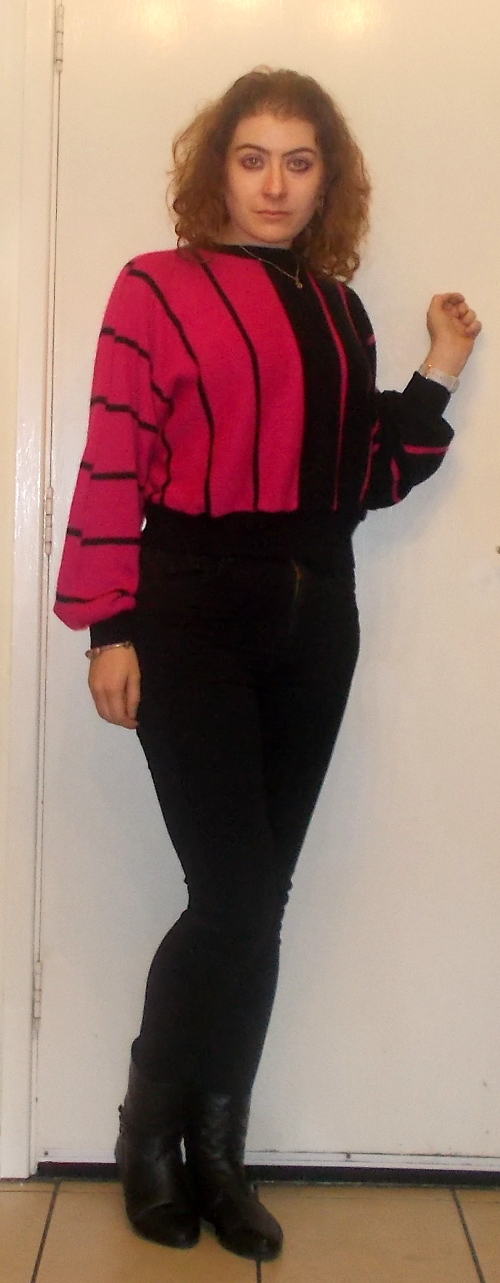
OOTD: my comfy, cosy new house dress from yesterday’s vintage haul – it came with a ‘free’ handkerchief in the pocket, which I only realised this evening. At least it was a clean one! Dress unknown brand (vintage 1980s, bought at vintage fair 2018), belt H&M (2017), tights Primark (2017), shoes La Redoute (2018).
Today’s earworm playlist:
Danny Wilson – Mary’s Prayer
Duran Duran – I Don’t Want Your Love
Irene Cara – Fame
I’ve not watched House (1986) for a while, though I vaguely remember Geth thinking it was the worst film ever. It was produced by Sean S. Cunningham (creator of Friday the 13th) and directed by Steve Miner (who later directed Halloween H20), which makes it a nice curiosity.
I love that daft tagline!
The opening is accompanied by some lovely ’80s spooky synth by Harry Manfredini. Very nice!
We open with a grocery delivery kid coming into the eponymous house to deliver groceries to elderly Elizabeth Hooper. He’s about to leave the groceries by the door, but decides to go upstairs to investigate a strange noise. Just leave the groceries like you were about to do, FFS! Upstairs, the kid finds Elizabeth’s body hanging from the ceiling, and is quickly outside and zooming off on his moped.
At the funeral, Elizabeth’s nephew Roger is being incompetently consoled by some other dude. Roger is a horror author, and at a book signing, we get his backstory: he’s not released any books for a while and is under pressure from his agent and publisher; he’s trying to write a Vietnam War memoir; and he’s divorced from actress Sandy Sinclair. At Roger’s home, we further find out that his son, Jimmy, has gone missing, and that he pretends to have friends over whenever Sandy calls.
After having a nightmare about Jimmy in a jungle, Roger goes to visit his aunt’s house. While being shown around by the estate agent, he has a flashback to when Jimmy disappeared, which happened while the family was visiting the house. There are lots of creepy paintings about, painted by Elizabeth, who believed the house was haunted.
As part of the flashback, we see Roger trying to explain to the police what happened. The detective is played by the same actor (Ronn Carroll) as the policeman who speaks to Alice at the end of Friday the 13th, which is a nice touch!
Roger decides not to sell the house and moves in, settling down to write his Vietnam book. Soon after arriving, he has a vision of Elizabeth, who says the house tricked her and that it ‘knows everything about you’. In the morning, Roger meets the neighbours – a pretty girl jogs by, and next-door neighbour Harold turns out to be a big fan of Roger’s books, which, as we will see, is going to be a bit of a theme.
Roger has a lot of flashbacks to the Vietnam War while writing, as you might expect. While serving, he was apparently friends with a nutter called ‘Big Ben’ who had no fear (and no brains, according to his fellow soldiers), and was constantly running into danger.
That night, at midnight, Roger encounters a monster in the cupboard. Rather than freaking out, he gets the old military fatigues on, rigs up some recording equipment and sets up a rope to open the cupboard again the following night. There’s no monster, but when the clock strikes midnight, he realises it’s time-sensitive, and prepares to open it again. Unfortunately, Harold shows up at exactly the wrong moment, which is also a bit of a theme in this film.
Harold has brought a ‘midnight snack’ for Roger, and at first seems to be quite a good guy, but not a believer in ghosts and monsters. He then steals Roger’s address book (so clearly not a good guy after all) and, rather interferingly, phones Sandy, claiming to be worried about Roger’s mental health. Strangely, she doesn’t question being contacted by a stranger, and says she’ll come to see Roger when she can.
Back in the house, more strange things are happening, with a stuffed fish coming to life and various axes and other sharp tools being telekinetically moved around and thrown at Roger. The next morning, ‘Sandy’ shows up, but turns out to be a monster in disguise, and Roger shoots her. Harold, hearing the gunshot, calls the police and reports a suicide attempt (bit of a leap!). When the sirens start wailing, Roger hides the monster-as-Sandy’s body and starts pretending to polish his shotgun on the porch – but he needn’t have worried, ’cause the cops also turn out to be big fans of his. I think I have new #novelistgoals after watching this film.
Roger ends up having the cops and Harold in for coffee by accident, largely because Harold invites himself, but manages to avoid them finding ‘Sandy’. After a fight sequence with the monster, we get some daft music choices, with a jaunty pop track playing while Roger prepares to bury the body.
The jogging girl from earlier is swimming in the house’s pool, and introduces herself as Tanya. Apparently Elizabeth used to let Tanya swim in the pool whenever she wanted, so she’s just gone ahead and continued doing that without checking with the new owner. Roger, who is distracted by trying not to let her notice the still-moving monster body at his feet, doesn’t seem particularly bothered. Once Tanya’s gone, he dismembers the body and buries the various parts of the monster in different areas of the garden.
More upbeat ’60s pop, with Dedicated To The One I Love playing during the montage of Roger’s preparations for the night’s monster-hunting. Unfortunately, said preparations are interrupted first by Harold’s dog digging up a monster hand from the garden, and then by Tanya showing up with her toddler son Robert, who (a) looks about eighteen months old and, as it’s mid-1986, is therefore the same age as me – high five, Robert, even though you’re clearly just a plot annoyance! – and (b) has the monster hand that the dog dug up attached to his back, leading to a daft farcical sequence where Roger has to chase Robert down, get the hand off him and flush it down the toilet, all without Tanya noticing. Tanya then insists that Roger babysits Robert, despite Roger’s protests. To keep Robert occupied, they watch Sandy’s show on TV, and Robert falls asleep on the sofa. Next time Roger checks on him, though, he’s disappeared, which is probably why it’s not a good idea to leave a kid unguarded in a haunted house.
As expected, the monsters have come out to try and capture Robert, meaning Roger has to fight them off to get him back. Robert seems remarkably unfazed by the whole thing, and eventually Tanya collects him without incident. With the coast clear, Roger brings Harold over for a session of ‘raccoon hunting’. Because the monster, when it appears, obviously doesn’t look anything like a raccoon, Harold is too freaked out to shoot straight with the harpoon Roger has given him. Roger is dragged into the house’s other dimension, and comes across a Vietnam scene with Big Ben lying injured, revealing the source of Roger’s war PTSD – when Ben begged him to kill him to put him out of his misery, Roger couldn’t do it and instead went off to find help, resulting in Ben being captured by the enemy and tortured for weeks before he died.
Roger escapes the other dimension, helps Harold to a sofa where he can sleep, and finds a painting that Elizabeth made of the trapped Jimmy. Realising that Jimmy is trapped somewhere in the other dimension, he smashes the bathroom mirror to find a way in, and uses a rope to lower himself down into the blackness, fighting the cupboard monster as he goes. Eventually, the monster breaks the rope, and Roger lands in a pool of water below. The music at this point is very reminiscent of Friday the 13th, which is understandable given that Harry Manfredini scored both films.
In an unexpectedly straightforward sequence, Roger finds Jimmy in a cage, unlocks it, and they both emerge in the swimming pool. It turns out to have been a creepy skeleton version of Big Ben that took Jimmy in revenge for Roger leaving him to get captured (although given what the vision of Elizabeth said about how ‘the house knows everything about you’, I’m guessing this is just the form the house’s evil force has taken in order to inflict maximum distress on Roger). After fighting Ben for a while, Roger throws him over a cliff that has appeared at the back of the house, but Ben reappears and catches Jimmy. However, Roger realises, somehow, that Ben can’t hurt either him or Jimmy. He grabs Jimmy and blows Ben up with a grenade, setting the house on fire. Harold runs out of his own house (how did he get back there after falling asleep on Roger’s sofa?) and Sandy arrives in a taxi at the same time, both catching sight of the flaming house. Of course, Roger and Jimmy soon emerge from the front door, and there’s a cheesy scene with Jimmy running into his mother’s arms and a freeze-frame on Roger with some ‘Vietnam war film’ victory music playing over the top. Roll credits!
Not a hugely satisfying ending, but the film’s a lot better than I remembered!
I had a really good day today. I got up and got ready to go to the two vintage fairs that were on in Newcastle, then came home and caught up with some more reading, to the relaxing background of Geth playing videogames (he’s currently playing West Of Loathing on our new Switch and also still getting on with Final Fantasy IX on the PS2).
I then watched Doctor Who and the Strictly results, which is fast becoming the only way to spend a Sunday evening. Why can’t autumn last forever?
OOTD: comfy bargain-hunting outfit. Duran Duran classic lineup t-shirt eBay/Fruit of the Loom (2018), jeans H&M (thrifted from Steff 2016), boots unknown brand (2018).
Today’s earworm playlist:
Elton John – I Guess That’s Why They Call It The Blues
Soft Cell – Say Hello, Wave Goodbye
Michael Jackson – Thriller
Sarah Brightman and Steve Harley – The Phantom Of The Opera
Michael Jackson – Rock With You
Well, this series is certainly keeping up with good storylines.
The Doctor has been trying to take Graham, Ryan and Yasmin home to 2018 Sheffield, but the TARDIS is not having it, and on the ninth attempt (‘Fourteenth,’ corrects Graham, who’s definitely my favourite of the new companions), it lands them in 1955 Montgomery, Alabama, where the Rosa Parks bus incident is about to go down. The Doctor notices that the TARDIS is detecting artron energy, which means they won’t be leaving any time soon, as she needs to investigate.
Again, the actual alien menace plot of this episode is fairly straightforward. Krasko is an escaped criminal from Stormcage (the prison where River Song was incarcerated during the Matt Smith era), who has decided that everything started going wrong when people started fighting for all that pesky ‘racial equality’ stuff, and has come to 1955 to make sure that the Rosa Parks incident doesn’t happen. Due to a Spike-from-Buffy-esque antiviolence block having been implanted in his brain, he can’t kill Rosa or anyone else, so he’s interfering with events to try and make sure that the circumstances don’t occur that led Rosa to make her bus protest in the first place, kind of like a less competent version of the Meddling Monk. Krasko’s fairly easily beaten, because the Doctor tricks him into destroying his own tools and then Ryan later sends him back into the distant past using Krasko’s own matter disperser, but in all honesty, he’s not the real villain in this episode.
The villainy, instead, is ably provided by the real-life ugly racism of the 1950s Deep South, with plenty of people around town who treat Ryan and Yasmin like scum. It’s well done and is, as intended, an uncomfortable watch. There’s also moments of joy, though – Ryan’s delight at getting to meet Martin Luther King is lovely, and Rosa Parks is characterised and played with a real fire and determination.
With Krasko dispatched, the real challenge for the Doctor and companions is mitigating all his interference, and so it’s that challenge that makes up the tense final sequence of the episode. It’s well plotted and very satisfyingly resolved.
Characterisation-wise, I’m still waiting for more from Yasmin, but Ryan was really well used this episode, and the relationship between him and Graham is developing really nicely. I’m also amazed by how quickly Jodie Whittaker’s Doctor has become part of the furniture in my brain – she’s warm and funny and may in the long run become one of my favourites.
Looks like they finally get back to Sheffield next week, so that’ll be interesting!
Two vintage fairs on in Newcastle today, both kilo sales. I have discovered that kilo sales are my new favourite thing.
Lots of funky ’80s patterns! Top (L-R): blouse, jumper, blouse, dress. Bottom (L-R): dress, blouse, dress, dress. I’m looking forward to wearing all of these!
I managed to get eight items of clothing for the price I would usually pay for two or three at a vintage fair, so I feel like I got some great bargains today!
I went to Worth The Weight Kilo Sale at the Civic Centre first. I’d managed to get a limited edition free entry ticket when they’d advertised them on Facebook, which meant more money for clothes! I’d intended to stick to lightweight dresses and blouses to try and get my money’s worth, and for the large part I stuck to that plan, but I couldn’t resist one jumper. I do love an ’80s jumper! At £15 per kilo, my 1.4 kilos came in at £21, which is not bad for a jumper, two dresses, and two blouses.
I then headed over to The Vintage Kilo Sale at Northumbria Student Union, which turned out to be the right way round to do things – by the time I got there it was past noon, which meant both discounted entry (£1.50 rather than £3) and discounted stock (£10 per kilo rather than £15!). This meant that I only had to pay £10 for my exactly-a-kilo haul of two dresses and a blouse.
Both fairs had a really good selection of late 20th century vintage (’70s to ’90s, mostly), which meant that my ’80s vintage wardrobe has grown significantly today. I’m already looking forward to when the next kilo sale rolls into town, and will be keeping my eyes peeled on Facebook!
The Wolf Man (1941) is considered to be the third big Universal monster film, even though it wasn’t released until a decade after Dracula and Frankenstein, when there had already been several sequels to those first two films. This makes it even more impressive that the monster captured the imagination so much.
This DVD cover doesn’t photograph that well, but the film looked really crisp on our 2010s TV.
The opening credits show us some clips of the characters, so that we know who’s who. Claude Rains (of The Invisible Man fame) plays Sir John Talbot, while Lon Chaney Jr plays his son Larry. This is slightly bizarre casting, as not only do they look absolutely nothing alike (Chaney is about a foot and a half taller than Rains, for a start), there doesn’t seem to be much between them in age. (There were actually seventeen years between the two actors, but Chaney had not aged well and hence looks nearly as old as his ‘father’!)
Meanwhile, Bela Lugosi plays a gypsy called Bela, which is fairly unoriginal naming. This is quite a minor part, and a fairly big step down from playing the lead in Dracula a decade earlier.
We open with a shot of the dictionary definition of lycanthropy. This isn’t really necessary, as werewolves will be thoroughly explained within the film.
The story opens with Larry Talbot arriving home to his father, Sir John Talbot, at the family country pile in England. Larry has spent the last eighteen years in the US, a plot point that is presumably meant to explain his accent (there are some fairly poor attempts at British accents in this film, but I guess Chaney didn’t fancy being one of them).
Sir John has been building a telescope. Larry has been working for an optical company in California, so is able to fix some minor problems with it. He immediately makes use of the telescope by perving on the girl in the house across the street, which is super creepy now but was apparently fine and dandy in 1941, as it’s presented as nice normal harmless fun for young men to partake in.
The costumes scream early ’40s, placing the film in a setting contemporaneous to its release. This is quite refreshing after the vague faux-Victoriana of all the other old films I’ve been watching during this horrorthon.
Larry goes to the shop below the girl’s house to meet Gwen Conliffe in person, and engages in more creepy flirting, telling her he’s psychic and hence knows what earrings she has in her room upstairs. Gwen’s not having it, thankfully. Larry buys a creepy cane with a wolf head on, causing Gwen to launch into a rhyme about werewolves, and insists on picking her up at eight despite her refusal.
Back at the Talbot house, the cane is shown to be far too short for Larry, unintentionally providing the film with a rare bit of comedy! Sir John, after reciting the werewolf rhyme at the sight of the cane, appears to encourage his son’s interest in Gwen, which is slightly uncomfortable.
At eight, Gwen shows up for the date, despite having refused Larry earlier…but it turns out it’s just because she wants to bring her friend Jenny along, as Jenny wants her fortune told by the gypsies who have just arrived in town.
Jenny recites the same rhyme about the werewolves. Why does everyone in the locality know this rhyme? ‘Everyone knows about werewolves!’ says Gwen, but it’s not explained why.
While Jenny is consulting with Bela, the gypsy fortune teller, Larry and Gwen go for a walk, and Larry confesses to having spied on Gwen with the telescope. Gwen is only marginally annoyed by this revelation, but explains she’s engaged to Frank Andrews, the gameskeeper for the Talbot estate.
Bela has a very ominous reading for Jenny, with lots of accompanying overacting. He sees a pentagram sign appear in her palm, and tells her to run. She does so, but is soon killed by a wolf in the woods. Larry, hearing Jenny’s scream, chases after her and kills the wolf, but not before getting bitten himself. Gwen soon finds the unconscious Larry, and an old gypsy woman comes to their aid. As they arrive back at the Talbot estate, the news comes that Jenny’s been found murdered. Bela is also dead – murdered using Larry’s cane.
In the morning, Larry’s wolf bite has disappeared. Resident police chief constable Montfort and family doctor Dr Lloyd at first seem to be fairly certain that Larry killed Bela, but this is soon forgotten for plot reasons. Larry follows Bela’s hearse to the crypt and looks inside the coffin, but is interrupted by the gypsy woman arguing with the priest, as she wants a traditional gypsy funeral celebration. Larry overhears her speaking some words over the coffin about Bela now being at peace from his suffering.
Gwen is disturbed by Jenny’s death and won’t take her father’s advice to rest. As Gwen sits in the parlour, Jenny’s mother shows up at the shop, and turns out to be a right moralising cow, accompanied by a gaggle of similar-minded women. She has a good go at Mr Conliffe about Gwen being out with a man who’s not her fiancé, and blames Gwen for Jenny’s death. Larry then arrives and gets rid of the women, as he wants to see Gwen. Before they can talk much, Frank shows up, also wanting to see Gwen, and his dog starts barking manically at Larry. Larry correctly realises it’s time to leave.
That evening, everyone in town goes to the gypsy carnival. At the shooting range, Frank challenges Larry to a game, but Larry finds he can’t shoot the wolf image that pops up. Weirdly, Larry is being observed by his father, who’s accompanied by Montfort as usual.
Larry goes to see the gypsy woman. She explains that Bela was a werewolf, and that the wolf Larry killed was Bela in wolf form. Larry doesn’t believe any of it, but the woman gives him a charm to protect him. As Larry leaves the tent, Montfort is shown watching a crowd of gypsy women hurriedly preparing for something.
Gwen is wandering the carnival by herself when Larry finds her, as she and Frank have apparently had a quarrel. Larry gives her the charm, then kisses her, because who cares that she’s engaged to someone else, right? Gwen runs away when they’re interrupted by the gypsy chaos, and Larry then has a weird montage vision of lots of strange images.
Larry gets home and transforms into the Wolf Man, with the transformation effect shown through his feet gradually getting hairier. I guess it was the best they could do in 1941. As a wolf, he kills the graveyard worker Richardson. Dr Lloyd and Montfort find the body, along with some animal tracks leading away from it.
Larry wakes up in different clothes (why did the Wolf Man bother to change clothes?) and finds his wolf bite is now visible, but looks like someone has drawn a star on him in biro. He hides the evidence of the muddy tracks in his bedroom, and shrinks back from the window when he sees Montfort looking at the tracks in the garden.
At the local church, Jenny’s mother is now spreading the rumour that Larry is the murderer. There’s then a slightly unnerving sequence where everyone stares at Larry when he doesn’t sit down in the pews. Instead, he leaves the church building.
Later that morning, Sir John, Montfort, Dr Lloyd and Frank are having a debrief about the wolf killings. Larry comes in and tells the other characters that it’s a werewolf. Frank and Montfort are sceptical and go off to set traps in the woods.
That night, the Wolf Man is caught in one of the traps, but the gypsy woman casts a spell to turn him into Larry again and releases him from the trap before the police dogs can find him. When the estate staff ask him what he’s doing in the woods, he claims to be hunting the wolf too, which is a pretty poor lie seeing as he’s barefoot and disorientated. Nevertheless, they don’t question him, because apparently the son of Sir John Talbot can do whatever he likes.
Larry throws a stone at Gwen’s windowframe to get her to come downstairs, and tells her he’s running away. She wants to come with him (poor Frank! I think he needs a better fiancée), but he sees the pentagram sign in her palm: the sign of the next victim. Larry runs back home, and Sir John tries to ease Larry’s mind by tying him to a chair so he won’t escape. Larry begs his father to take the cane with him when he goes out to the woods, so as to protect himself.
The gypsy woman is out in the woods doling out sensible advice, but nobody listens to her. The Wolf Man inevitably gets out and attacks Gwen, who is looking for Larry; Sir John then beats him to death with the cane, and in front of him, the gypsy woman casts the same spell she did over Bela’s coffin to turn the Wolf Man’s body back into that of Larry. (This is a huge plot hole – Bela turned back from a werewolf into his usual self after he died, because when his body was found, nobody noticed anything out of the ordinary. So why did the gypsy woman need to cast the spell over the coffin? And why does she need to cast the spell now to turn Larry’s werewolf body back into a human one?)
Displaying the same kind of logic he’s been doing all film, Montfort arrives on the scene and declares, ‘The wolf must have attacked her [Gwen] and Larry came to the rescue. I’m sorry, Sir John.’ The End! It’s a bit of an abrupt, confusing ending, so I’m quite interested to see if the sequels provide any further explanation.
Geth and I made the decision not to go to parkrun this morning, because we both needed a full day to unwind. Geth’s been videogaming all day, and I’ve been catching up with reading. It’s been really nice and I feel much better and less harried for it.
It was also nice to watch the main Strictly show tonight. Everyone on it is really good this year!
OOTD: I feel like I wear this outfit a lot, but I do love it! Jumper unknown brand (vintage 1980s, bought at vintage fair 2017), jeans Levi (2018), boots Carefree (2017).
Today’s earworm playlist:
Duran Duran – Ordinary World
Sarah Brightman and Steve Harley – The Phantom Of The Opera
The Phantom Of The Opera (1925) is the second silent film in this month’s horrorthon. I’m always interested to see what the backing track is on the DVD for these films!
Before we start, though – if you’ve been reading this blog for any length of time, you’ll know I can never resist a gratuitous ’80s music video, and when it comes to The Phantom Of The Opera, the Now! ’80s channel has been amply providing recently, with lots of videos made for songs from the Andrew Lloyd Webber musical version.
One of the videos they’ve been playing is this super saccharine performance of All I Ask Of You, with Sarah Brightman singing the Christine part (as ever – she also played the role in the stage musical) and Cliff Richard singing the Raoul part. Try not to watch the gross and awkward kiss in the middle of the video. Ewww!
Another one that comes on all the time is the video for the title song, with Sarah Brightman as Christine again and Steve Harley (he of ’70s glam rock fame as frontman of Cockney Rebel) as the Phantom. Apparently he was meant to play the Phantom in the stage musical but got acrimoniously replaced by Michael Crawford. Geth absolutely hates Steve Harley’s performance and won’t stop ranting about it whenever the video comes on!
Um, yeah, so we weren’t meant to be talking about the 1986 musical version, were we? I don’t think the 2004 film of the musical even counts as a horror film. I suppose we should crack on with watching the 1925 version.
The scene that this image represents is nowhere near as epic in the actual film.
The Phantom, in this version, is played by Lon Chaney, not to be confused with his son Lon Chaney Jr who played the Wolf Man and various other characters in the Universal monster movies during the ’30s and ’40s. Chaney Sr pulls off a brilliant performance, and is the best thing about the film.
The backing music on this DVD version is great from the off!
The setting for the story is the Paris Opera House, which was built over mediaeval torture dungeons. Usually in a horror film, I would ask why someone was stupid enough to build over somewhere that’s clearly going to be haunted, but I’m from Edinburgh, where the whole city is basically built over blocked-off medieval plague streets. In crowded European cities, that’s just the way it rolls – when you run out of space you start building on top of yourself.
There’s a pretty scene at the start with lots of ballet dancers on the stage, and appropriate performance music. Meanwhile, a deal is being done in a side room – the Opera House is being sold. The new owners are told about the ghost, but they laugh it off in glorious ’20s silent overacting style.
We’re introduced to the mystery of the cloaked figure in Box Five – apparently seeing his back is so terrifying that the owners run away at first, then find he’s disappeared when they look again.
We then cut to a fairly farcical sequence with about twenty ballet dancers running around the dungeons, frightened of the Phantom, and it’s not very clear what’s going on. ‘The Phantom is up from the cellars again!’ says one. One of them claims he has no nose (and I’m disappointed that nobody makes the classic ‘how does he smell?’ bad joke – maybe it hadn’t yet been invented in 1925), but another rebuts, ‘Yes, he did, it was enormous!’, indicating that the dancers probably haven’t actually seen the Phantom. A suspicious-looking man then appears from the cellars and goes upstairs, to the confusion of the dancers. During this sequence, they all run about in a pack, looking like little girls at play in their party dresses, which is a bit alarming given that they’re meant to be grown women.
The dancers speak to Joseph Buquet, one of the opera stagehands, who’s the only person who’s actually seen the Phantom. He launches into a florid description of holes in a grinning skull, yellow skin etc. – suffice to say the Phantom’s pretty ugly. Buquet also confirms he’s got no nose. Another stagehand tells Buquet off for riling the ghost. Anyway, Buquet shows them where he saw the Phantom, and all the others look terrified and run off, resulting in another few minutes of balletic running. There’s then another farcical bit with the fleeing stagehand accidentally climbing up through a stage trapdoor and getting chased off by some other workers.
Some dramatic music announces the formidable mother of Carlotta, the prima soprano at the Opera House. The Phantom has written to Carlotta, threatening her and expressing desire for Christine Daaé to sing the part of Marguerite in Faust instead. Despite the mother’s assertions that Carlotta won’t be threatened by ghosts, her daughter falls ill on the night – the Phantom apparently has some kind of supernatural power.
I still absolutely love this dynamic soundtrack – during the scene with Christine performing Marguerite, we get a track of operatic singing (I don’t know the opera but I presume the song is indeed from Faust), which is the only voice heard over this silent film.
There’s some mild drama with Philip de Chagny, brother of Comte Raoul de Chagny, suspecting Christine of being unfaithful to Raoul, but this isn’t really followed up. Raoul is not a very exciting love interest, but at least he’s not performed by Cliff Richard in this version. Boringly, he wants to get married straight away; Christine says she wants to stay in the Opera instead, because women couldn’t do both back then. Raoul leaves, and we see that a strange ‘melodious voice’ is speaking to Christine. ‘Tonight, I placed the world at your feet!’
We get another scene with Carlotta’s mother and her signature music. Carlotta is still being threatened, as are the opera owners (‘You will present Faust in a house with a curse on it!’). Neither feel particularly threatened (the mother thinks it must be Christine’s friends), and so Carlotta appears as scheduled. Raoul receives a note from Christine during the performance, telling him not to contact her again.
The ‘curse’ makes itself felt – the stage lighting starts playing up, and the opera house’s giant chandelier falls on the audience, causing panic. Among the confusion, there’s a bizarre faceoff between Raoul and the suspicious-looking man from earlier, where they just stare at each other for a few seconds. Raoul hides in Christine’s room and overhears a conversation between her and the Phantom. Christine goes through a secret mirror passage, which closes before Raoul can see where she went.
The Phantom approaches Christine, wearing a strange featureless mask. Apparently he’s ‘brought her the gift of song’, suggesting that she’s only able to sing so well because he’s cast some sort of spell. Christine seems hypnotised or somesuch, and faints. The Phantom loads her onto a horse that just conveniently happens to be standing there, and leads the horse away.
The Phantom takes Christine to his lair via boat across a hidden black lake, leading to a very pretty shot with her veil trailing in the water. In the lair, he declares his love in a very creepy way, and Christine runs off. She’s confronted by a large coffin in the side room. Apparently the Phantom sleeps in the coffin to remind himself of the sweet, sweet death that will come one day. He’s not a wannabe vampire, more of a proto-goth.
‘You’re the Phantom!’ gasps Christine, who’s apparently a bit slow on the uptake. ‘If I am the Phantom, it is because man’s hatred has made me so…if I shall be saved, it is because your love redeems me!’ claims the Phantom. Apparently his real name is ‘Erik’. This news causes Christine to faint again. I can’t stand these early female film characters!
We then get some pictures of newspaper headlines, which seems to have been a fairly common technique in silent film. ‘Christine Daaé Disappears Following Chandelier Disaster’.
Following a ‘night of vague horrors and tortured dreams’, Christine wakes up to a display of about six pairs of beautiful OMG SHOES! That would totally have won me over. Not so much the bridal veil and dress, which are totally creepy. The Phantom has left her a note, explaining ‘You’re in no peril as long as you don’t touch my mask’.
In comes the Phantom’s creepy organ music, which is the music most iconic to the story as far as I’m concerned! It seems to hypnotise Christine. The Phantom says the piece is Don Juan Triumphant (again, I’m not familiar with that piece of music so I don’t know if the organ music on the soundtrack actually matches this), apparently to signify love being triumphant, but with an ‘undercurrent of warning’. How romantic.
Christine, ignoring the note’s warning, rips the Phantom’s mask off at the dramatic climax of the music! The Phantom’s ‘deformed face’ makeup is brilliant, and was apparently created by Lon Chaney himself, who came from the old theatrical tradition where actors did their own makeup. Contrary to Joseph Buquet’s assertion, he does have a nose. ‘Feast your eyes, glut your soul on my accursed ugliness,’ moans the Phantom, whose dialogue apparently gets even more pretentious when he’s not wearing his mask.
Christine begs to leave, and the Phantom agrees, in order ‘to prove [his] love’. ‘But remember you are mine – mine – and you shall not see your lover again! If you do, it is death to you both!’ Charming guy. The frightened Christine agrees, but immediately breaks her promise by sending a note to Raoul, telling him to meet her at the Bal Masque de l’Opera.
We get a medieval calligraphy caption introducing the setting of the Bal Masque de l’Opera, and the footage for this sequence is colourised in this version, showing the attendees’ pretty costumes. Unfortunately, the Phantom shows up in costume to spoil the party. ‘Beneath your dancing feet are the tombs of tortured men – thus does the Red Death rebuke your merriment,’ he informs the partygoers, cheery as ever.
Christine and Raoul miss this doomy pronouncement, because they’ve escaped to the roof of the Opera House for a private conversation. ‘Are we alone, Raoul?’ asks Christine. Why’s she asking him? Can’t she judge for herself? Anyway, she tells Raoul about the Phantom…who also happens to be on the roof with them, having apparently hotfooted it from the main floor of the building.
Christine explains that the Phantom has put an illness curse on Carlotta again, meaning that Christine will be playing Marguerite the next night. How is the Phantom managing this? He’s clearly not a supernatural being, just a deformed man. Christine and Raoul plan to flee to England as soon as the performance is over. ‘She has betrayed me!’ wails the Phantom to himself. Why is this a surprise? Did he actually think his actions had won her over?
The suspicious-looking man is still creeping around. ‘Not that way, this way,’ he says to Raoul and Christine as they come down from the roof. There’s then a strange scene where a partygoer, who is fencing in costume as a musketeer, recognises the Phantom despite the latter’s costume and immediately faints. Silly, but I’m glad to see it’s not just the women randomly fainting in this film!
The suspicious-looking man comes to speak to the opera house owners. Ah! He turns out to be some kind of detective, and delivers them a letter. The Phantom, or ‘Erik’, is apparently an escaped violent criminal who was previously incarcerated.
Before the performance, Christine tells Raoul that the Phantom knows their plans – she has heard his voice again. She begs Raoul to save her; he’s sure the escape will be straightforward.
Down in the cellars, a hanging body freaks the main stagehand out. ‘Come quick! The strangler’s work again!’ There’s more group running, this time with stagehands instead of ballet dancers, but the body has been moved to the floor – it’s Joseph Buquet, who ‘knew too much about the Phantom’. His brother Simon vows to hunt the Phantom down.
We basically get lots of free tracks from Faust on this soundtrack, with both Christine and Carlotta singing various numbers as Marguerite.
While Christine is onstage, the Phantom grabs and kills one of the owners and appears in his place in the viewing box, causing Christine to scream. Her Marguerite wig is found on the floor in the confusion – she’s gone again. While Raoul is investigating the secret mirror, he’s joined by the detective, who introduces himself as ‘Ledoux of the Secret Police’.
Ledoux tells Raoul that the dungeons are ‘where he [the Phantom] himself was confined during the second revolution’. This throws the setting of the story into doubt. Up until now, due to the the fact that the costumes look very 1890s, I assumed that it was set around the turn of the century. If the ‘second revolution’ – which can apparently refer to either 1792 or 1830 – is within living memory, it must be set earlier, which completely contradicts the costuming.
In the cellars, there are lots of people wandering about. Raoul’s brother Philip is hanging around with a lantern, and some random stagehands are down there too. Ledoux somehow knows that Joseph discovered a trapdoor, which is why he got killed.
The Phantom, as expected, is angry with Christine. ‘You have spurned the spirit that made you great!’ He then launches into a rant that’s so florid I can’t tell whether he’s threatening to rape her or hypnotise her into loving him.
Meanwhile, Raoul and Ledoux fall ten feet down a hole to the cellar below, but they’re both perfectly fine.
‘I am human like other men – I will not be cheated of my happiness!’ rails the Phantom, which is horrifyingly reminiscent of the kind of creeps you get in today’s society who think they’re somehow owed sex and affection from women.
The Phantom overhears Philip, who has found the black lake, shouting for Raoul. The Phantom leaves Christine alone in the lair, wades into the water (ew), and goes snorkelling. Raoul, in another part of the cellar, calls for Christine, and she hears his voice through the wall. Meanwhile, the Phantom overturns Philip’s boat and kills him by drowning (how come nobody in these older films can ever swim?).
Raoul and Ledoux, on the other side of the door to the lair, tell Christine to look for the keys. Unfortunately, before she can find them, the Phantom returns with a campy villain line (‘The callers have departed.’) and returns to his seat at the organ.
Simon Buquet has discovered the Phantom’s hiding place and organises an angry mob of stagehands, so we get a nice ‘flaming torches’ procession going into the Opera House.
The Phantom catches Christine with the keys and then overhears Raoul in the next room. He’s apparently super prepared for such eventualities and turns up the heat, trapping Raoul and Ledoux. We get some great juxtaposition here between the three sequences of the angry mob, Raoul and Ledoux, and Christine and the Phantom, which are all colourised differently.
‘What do you offer for their lives?’ asks the Phantom. Ledoux finds an escape hatch from the overheated room, but the next room’s full of gunpowder. There’s then a weird sequence with some controls shaped like a scorpion and grasshopper, which the Phantom forces Christine to choose between – the scorpion to save Raoul’s life and submit to marriage with the Phantom, and the grasshopper to blow the whole Opera House up. She eventually chooses the scorpion, but it causes the water from the lake to flow into the gunpowder room. Christine begs the Phantom to rescue Raoul and Ledoux from drowning. After he’s done so, the angry mob arrive in the lair.
The Phantom runs off with Christine. Raoul, at first, is too weak to go after them, but after a moment he and Ledoux give chase alongside the angry mob. The Phantom steals Raoul’s waiting carriage, driving off with Christine in the back, but Christine escapes the carriage by jumping out. Before the Phantom can retrieve her, the mob catches up with them and Raoul runs to Christine’s side. We then get a chase through Paris with all its pretty architecture (well, actually through a Hollywood studio set, presumably, but they did Paris quite well).
The Phantom is killed by the mob and thrown in the Seine, and we get the ‘Finis’ screen.
In addition to the original film credits, we also get some credits for this particular version – apparently the soundtrack was done in the ’90s by a Canadian company. They did a really good job!
One sidenote is that I want to read the original book now – I think it would help me to make more sense of the story.
A busy day today. I spent the morning working, then in the afternoon Geth and I went out to the cinema. This evening, Geth set up a new TV and games console, so we’ll be experimenting with that a lot this weekend!
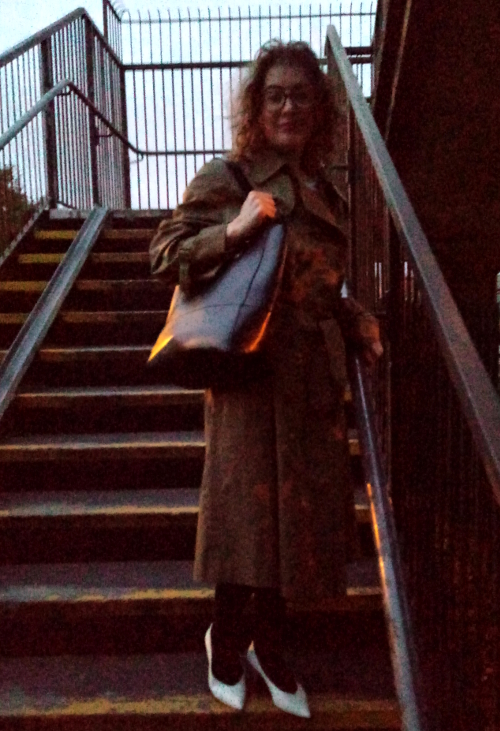
OOTD: autumn is trenchcoat season! Glasses Emporio Armani (2017), bag CXL by Christian Lacroix (2018), trenchcoat Burberry (vintage 1980s, bought on Etsy 2018), tights Primark (2017), shoes Office (2018).
Today’s earworm playlist:
Duran Duran – I Don’t Want Your Love
USA For Africa – We Are The World